Por plato, no por hora
Por qué cobramos por alcance fijo y no por hora — qué cambia para ambos lados, a qué clientes filtra, y qué hacemos cuando el alcance crece igual.
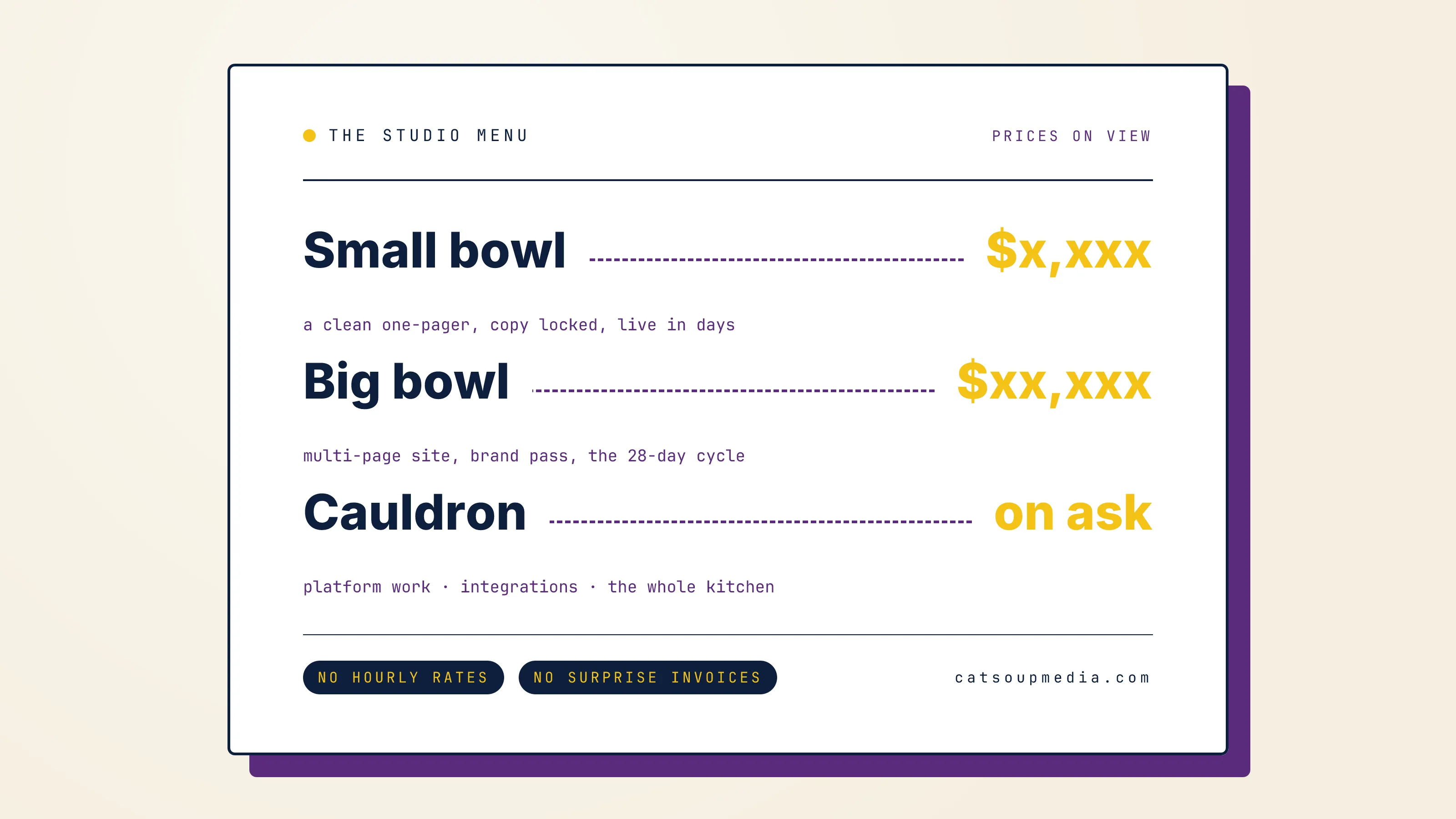
We don’t sell hours. We sell a thing — a site, a campaign, a custom tool — at a price agreed before the kitchen turns on. We call it “per bowl.” A small bowl, a big bowl, a cauldron. Pick one. The price stays put.
This isn’t a hot take on hourly billing. It’s an explanation of why the alternative — fixed scope at a fixed price — works better for the kind of work we actually do, and for the kind of clients we want.
Hourly is already the minority
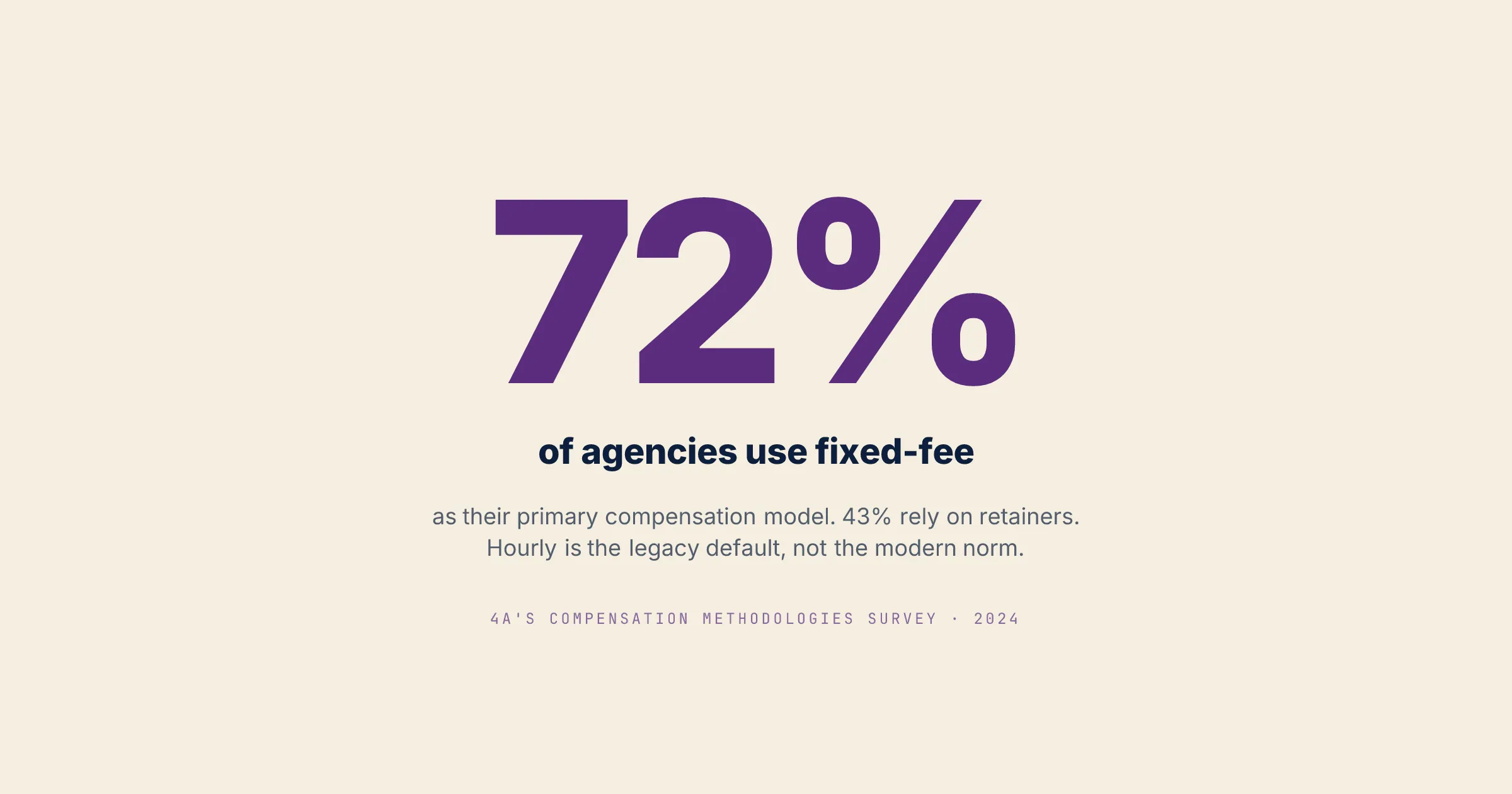
The first thing to notice: in 2026, hourly is no longer the default among agencies, even if it’s still the default in client expectations. The 4A’s 2024 Compensation Methodologies Survey reports that 72% of agencies now use fixed-fee as their primary compensation model, and 43% rely on retainers as their most popular package. Among large management consultancies — the firms historically synonymous with the meter — even McKinsey is moving away. CEO Bob Sternfels, on HBR’s January 2026 podcast, said outcomes-based pricing now covers roughly a third of the firm’s revenue and that he hopes “the majority of the revenues” will be outcomes-based before his term ends.
So when we say we don’t bill hourly, we’re not making a contrarian flex. We’re using the model the rest of the industry has already mostly moved to. The contrarian thing now would be defending hourly.
The incentive problem
Hourly contracts quietly bake in a misaligned incentive: the longer a thing takes, the more we get paid. Every studio that bills hourly will tell you they don’t think that way — and most of them genuinely don’t, day to day. But the structure still nudges.
Jonathan Stark, who’s written more about this than anyone, puts the mechanism cleanly:
Hourly billing for professional services is a horrible practice for everyone involved. It devalues the expertise of the consultant and encourages mistrust in the client because the financial incentives of the two parties are misaligned.
And, more sharply:
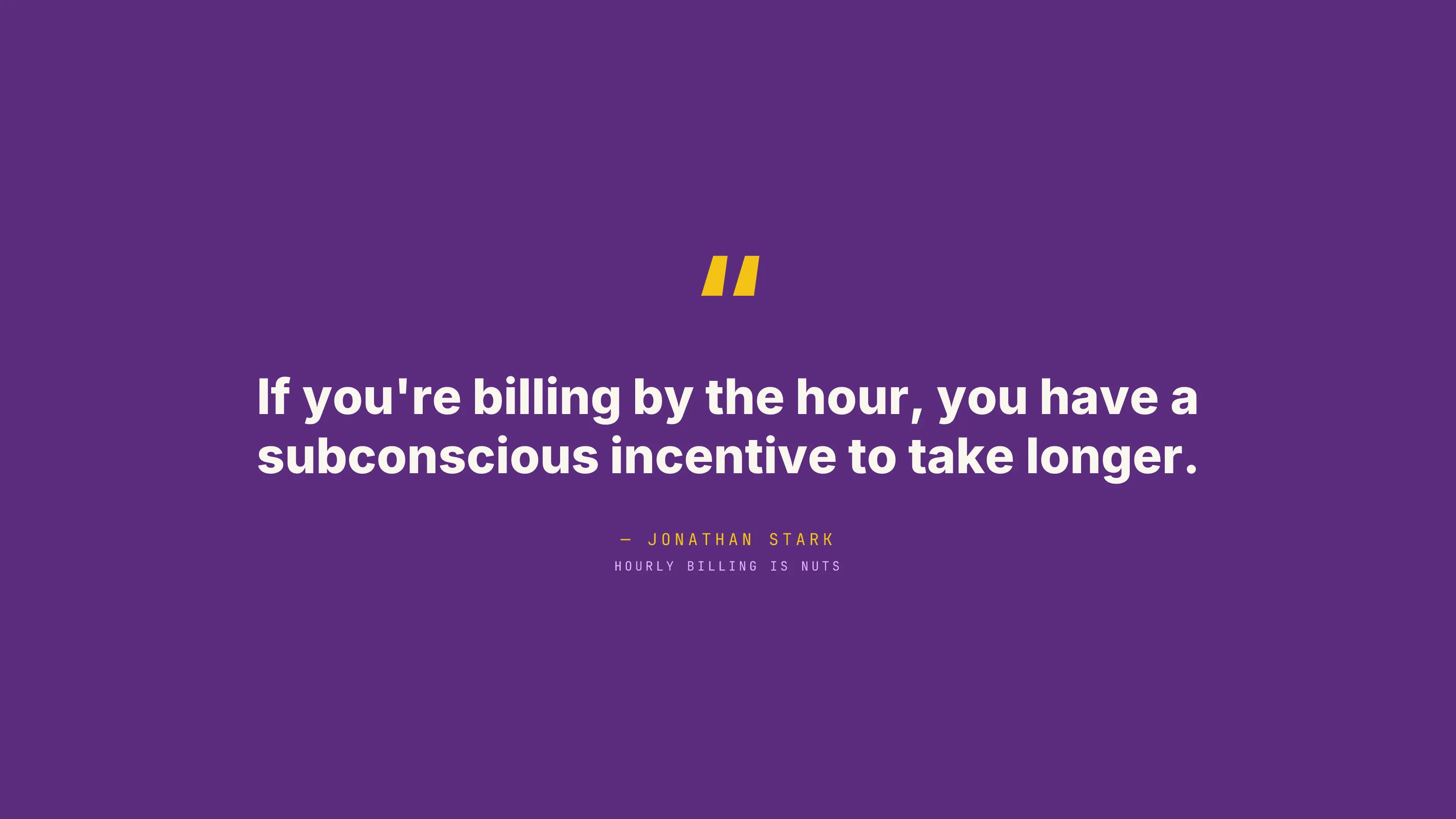
That’s the smoking gun. Slow Mondays don’t hurt anyone. Re-doing something with a slightly different approach earns more. Discovery calls stretch.
Clients feel the nudge from the other side: every minute on a call is metered. So they hesitate to call. Briefs get longer because shorter ones might “miss something” and trigger billable revisions. The relationship grows defensive on both sides.
Fixed scope flips the question. “How do we deliver this well?” replaces “How many hours did this take?”
There’s also a business-outcome argument. The Wow Company’s BenchPress 2025 survey of 600+ UK agencies found that agencies using value-based pricing were more likely to see fast growth (26%+ fee-income increase year over year) and had the highest gross-profit percentage in the sample. Fixed and value-based pricing isn’t just a values choice — it’s empirically the model that correlates with the agencies doing best.
What “per bowl” actually means in practice
Three things, every time:
- A written brief, signed off before the clock starts. Page count, sections per page, what’s in scope and what isn’t.
- A fixed price tied to the brief, paid in two tranches: 50% at kickoff, 50% at launch.
- A fixed deadline — 28 days for Standard, 6–8 weeks for Premium, scoped per project for Elite.
If the brief is too vague to price, the brief isn’t done. We don’t quote a range and “true it up later.” We go back to the brief.
What it filters out
Per-bowl pricing isn’t for everyone, and that’s the point. It tends to filter out:
- “I’ll know it when I see it” buyers. Without a brief, we can’t quote. Without a quote, we can’t start. We’ve lost work this way, and that’s fine.
- Clients who want to negotiate scope mid-build. Fine, but it’s a paid amendment, not a vibe.
- Hourly stop-and-go retainers. “Send us an invoice when you hit 40 hours” is a different studio’s business model. Not ours.
What it tends to attract:
- Founders who’ve been burned by open-ended agencies. They’ve paid 6-figure builds that were “almost done” for 6 months. Fixed price is a relief.
- Small operations that need a hard number for their finance person. “Between $X and $Y” doesn’t survive a finance review.
- Repeat clients. Once they’ve done one bowl with us, they ask for the next bowl by name.
What we do when scope creeps
It does. Usually mid-week 2. Two things are true at once:
- The new request is real — the project would be better with it.
- The brief said no.
We have a short conversation. There are three honest paths:
- Park — add it to the v2 list, ship the original brief. This is the default and the one most clients pick once we frame it.
- Pay — quote a small amendment, slot it in. Used when the new request is genuinely critical.
- Push — agree to swap something out of the original brief to make room. Same scope, same price, different ingredients.
We don’t do option four — “absorb it.” Once a studio absorbs a request, every request after that becomes negotiable. The brief stops being the contract.
The brief is the contract. The price respects the brief. The deadline respects both.
The steel-man for hourly
We’re not pretending the model has no risk on the studio side. Fixed-price contracts can fail in spectacular ways: the Standish Group’s CHAOS research shows only about 31% of IT projects fully succeed, with ~50% “challenged” (over budget, over time, or under-scope) and ~19% cancelled outright. Flyvbjerg and Budzier’s Harvard Business Review analysis of large IT projects finds that one in six runs over 200% on cost. PMI’s 2024 survey reports 57% of organizations call budget overruns a frequent occurrence.
If you fix the price and the project explodes, you eat the cost. That’s real.
The honest answer isn’t to bring back hourly — it’s to structure scope so the risk is bounded. We follow a Shape Up–style logic: fixed time, variable scope. The deadline doesn’t move; what does move is the optional features list, which we cut from in week 3 if the build is running hot. That’s how a fixed price stays honest without becoming reckless.
When hourly actually does make sense
We’re not pretending the model is universal. There are jobs where hourly is the honest answer:
- Ongoing care plans — bug fixes, content updates, security patches. We charge a flat monthly retainer, but it’s denominated in hours per month for transparency.
- Research-only engagements — when the deliverable is the thinking, not the artifact. Rare for us. We refer those out.
- Pure consultation — a single founder-call, $X per hour. We bill these in two-hour blocks; no minimum.
For the bulk of what we ship — sites, campaigns, custom tools — fixed scope wins on incentive, on cashflow, and on the conversation it produces.
The simple version
Hourly billing puts a meter on the conversation. Per-bowl pricing puts a number on the outcome. We’d rather argue about the outcome.
If you’ve ever paid an agency and walked away wondering what the last $5k of the invoice actually bought, you already know which one we’re doing.
— The Money Cat