El sitio en 28 días: qué entra, qué espera
Cómo se desglosa nuestro ciclo de cuatro semanas — qué va en cada semana del paquete Standard y qué se queda para la v2.
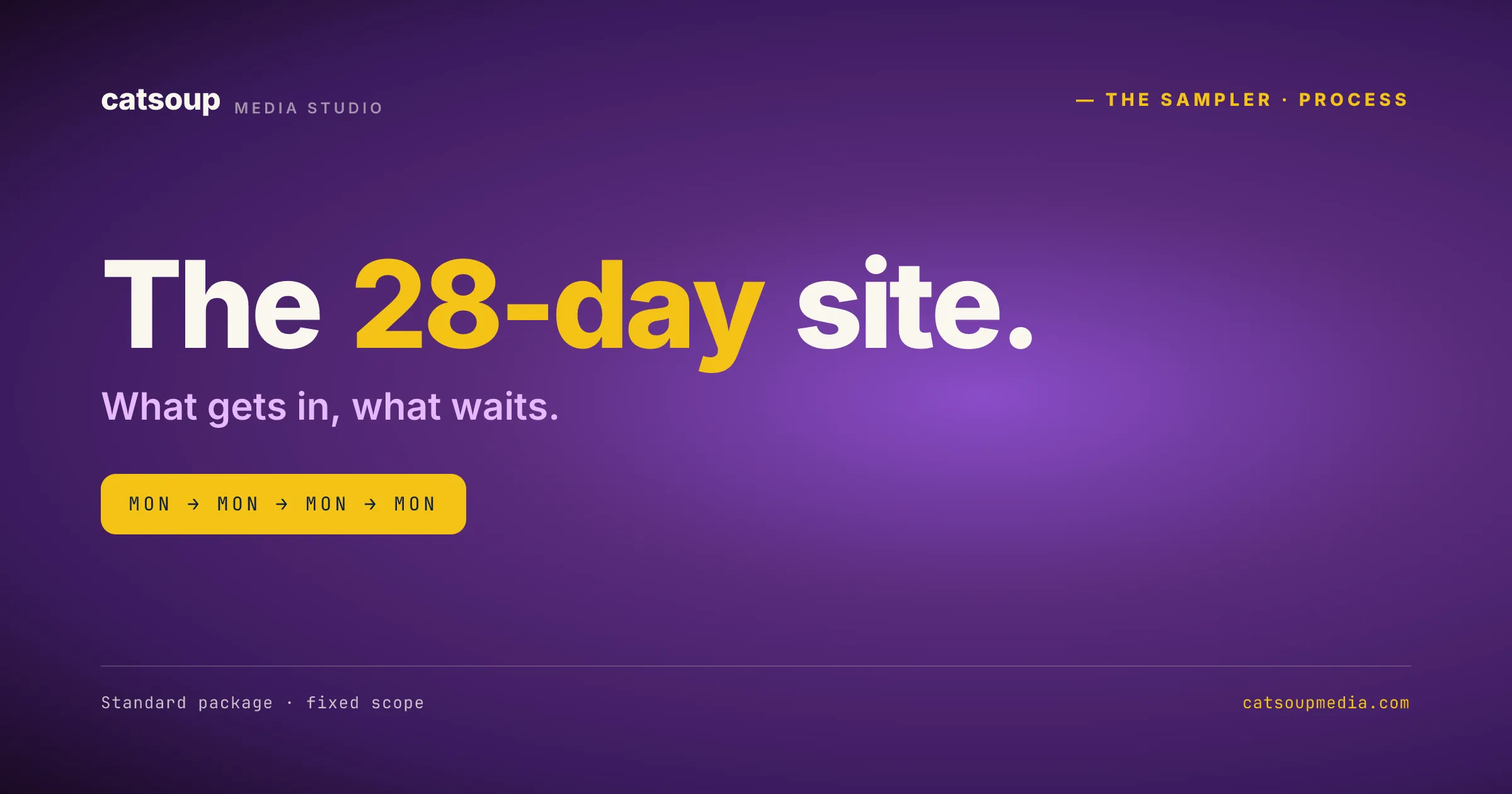
“How fast can you ship?” is the second question every prospect asks. The answer at the Standard tier is the same every time: 28 days from kick-off to a live, indexable site. Not “around a month.” Four weeks. Four Mondays.
What follows is the actual breakdown — what makes the cut, what gets parked, and why we say no to the things we say no to.
Why four weeks (not three, not six)
The agency-industry baseline is wider. Basic small-business sites typically take 4–6 weeks; standard sites 6–10 weeks; complex builds longer. A 28-day cycle puts us at the fast-but-credible end of that range — not a gimmick sprint, not a marathon.
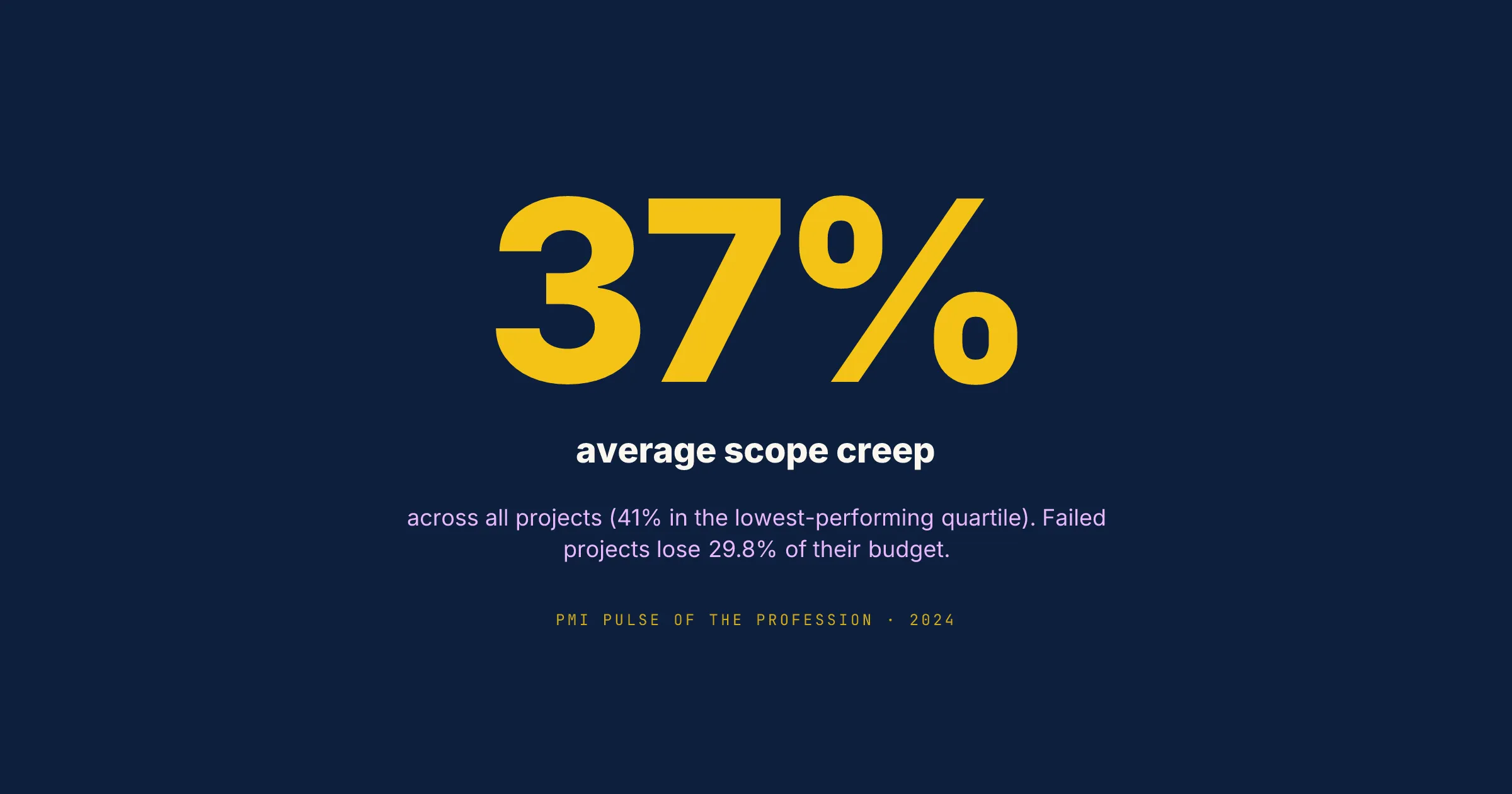
Three weeks isn’t enough room for real content work. Six weeks is enough room for scope to leak. PMI’s Pulse of the Profession 2024 puts the average scope creep across all projects at 37% (41% in the lowest-performing quartile), with failed projects losing nearly 30% of their budget.
Four weeks hits the sweet spot where a small brand can stay engaged from kickoff to launch without losing momentum — and where we can plan the menu without having to re-plate halfway through.
Why fixed cadence beats best-effort
The cadence isn’t just a constraint, it’s a feature. Ariely and Wertenbroch’s 2002 MIT study put it cleanly: externally-imposed evenly-spaced deadlines outperformed both self-imposed and end-only deadlines on actual project quality and on-time delivery. People with a deadline imposed on them do better work than people who set their own. We take the role of imposing the deadline.
There’s also cashflow math behind it. AIGA’s payment guidance for design firms recommends a 50% deposit on signing and 50% on delivery with Net-30 terms. Under that structure, a 28-day build closes its receivables roughly 60 days out from kickoff. An 8-week build closes them around 120 days out. For a two- or three-person studio, that 60-day gap is the difference between making payroll and chasing it.
The clock starts the Monday after sign-off and contract. It ends four Mondays later with a live site. We mark progress at the Monday morning standup; nothing else moves the date.
The rule: the launch date is the cadence. Scope flexes around it.
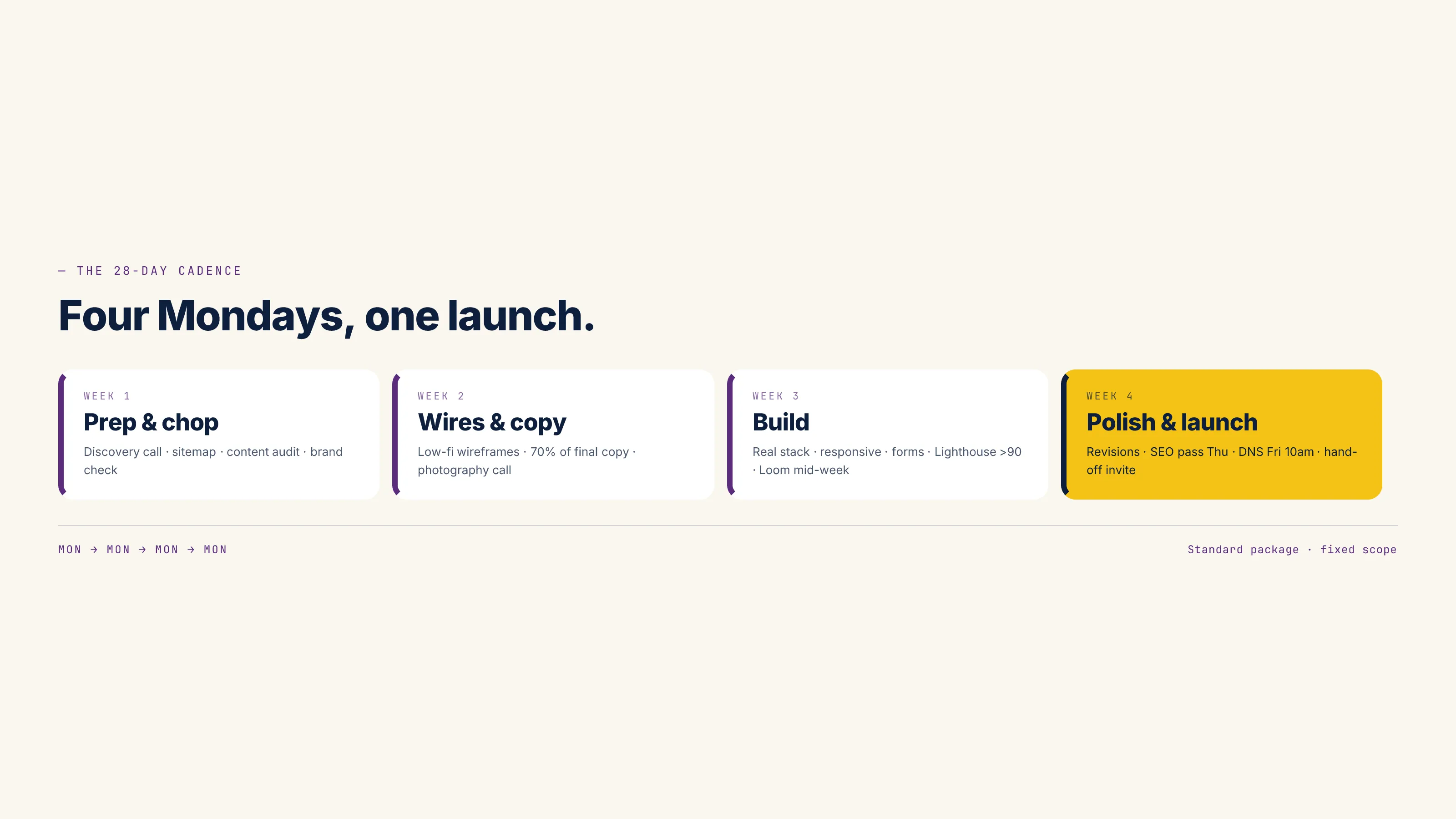
Week 1 — Prep & chop
The first week is mostly listening and choosing.
- Discovery call — 60 minutes, the founder and the dev. We come out with a written brief (one page, not ten).
- Sitemap — usually 5–9 pages. We argue for fewer.
- Content audit — what’s reusable from the existing site, what we’re rewriting from scratch.
- Brand check — colors, type, photography. If there’s no system, we propose one — but only what the site needs, not a full identity refresh.
Week 1 ships nothing visible. That’s normal. If you’re nervous on Friday of week 1, you’re paying attention; we don’t panic and we don’t show you a draft to soothe it.
Week 2 — Wireframes & copy
Now we plate. Low-fi wireframes for every page, all in one Figma file. Headlines first, body second. Real client names if we have them.
- Page-by-page copy outline — bullet points, not paragraphs. We need to know what each section is trying to do before we polish the words.
- Copywriting first pass — written by us, reviewed by you. Around 70% of what ships goes in this week.
- Photography call — what we already have, what we need, who’s taking it. If the answer is “stock,” we say so.
This is the week scope is most likely to wobble. The fix is the brief: if a request isn’t in the week-1 brief, it’s a v2 candidate.
Week 3 — Build
We move into the actual stack — Astro, WordPress, Webflow, or whichever fits the client’s editing reality. By Friday, every page is built, populated with real copy, and viewable on a staging URL.
- Responsive pass — phone, tablet, desktop. No “mobile later.”
- Forms wired — contact, lead magnet, whichever the brief listed.
- Performance pass — Lighthouse > 90 across the home, archive, and a detail page. Modern stacks make this reachable in a 4-week build window; both Astro’s islands architecture and Webflow’s recent CWV work routinely produce 90+ scores.
- Analytics in — basic events, not a dashboard. We wire the dashboard separately if it’s in scope.
Mid-week we send a Loom walkthrough. That’s the moment we expect substantive feedback. After Friday, requests stop being free.
Week 4 — Polish & launch
- Monday–Wednesday: revisions from the week-3 Loom. Copy tweaks, image swaps, micro-spacing.
- Thursday: SEO pass — meta, OG cards, sitemap, robots, schema.
- Friday morning: DNS cutover. We aim for ~10am local — full day to babysit before the weekend.
Hand-off is a calendar invite, not a “ping me if you need anything.” Forty-five minutes of training, recorded.
The hosting + care plan starts the following Monday. So does the v2 conversation.
What gets parked for v2
A short, non-exhaustive list of the things we cheerfully push:
- Custom WebGL / 3D anything. Beautiful, but never fits in week 3. We default to flat or scroll-pinned interactive only.
- A second language. Adds 3–5 days of pure content QA. Better as a v1.1 once primary content settles.
- Booking / scheduling integrations. Plug-and-play platforms (Calendly, Cal.com) fit; custom calendars don’t.
- Anything that needs legal review. Compliance copy, data-sharing flows, regulated-industry boilerplate — those move at lawyer speed, not studio speed.
- A blog with five day-one posts. A blog scaffold fits. Five posts, with images, in week 2, do not.
This isn’t a rejection list — it’s a v2 list. We commit to revisiting in week 5 when the dust settles and the analytics start telling a clearer story.
Where 28 days sits in the market
Fixed-cadence packaging is an established category, but the lengths cluster at two ends. Five-day GV/Knapp design sprints solve brand exercises. Groove and similar agencies run 2-week sprints for landing pages. Zypsy and other brand-system shops sell 6–8 week packages, often $45k+. Passionate offers $2,999 two-week sprints.
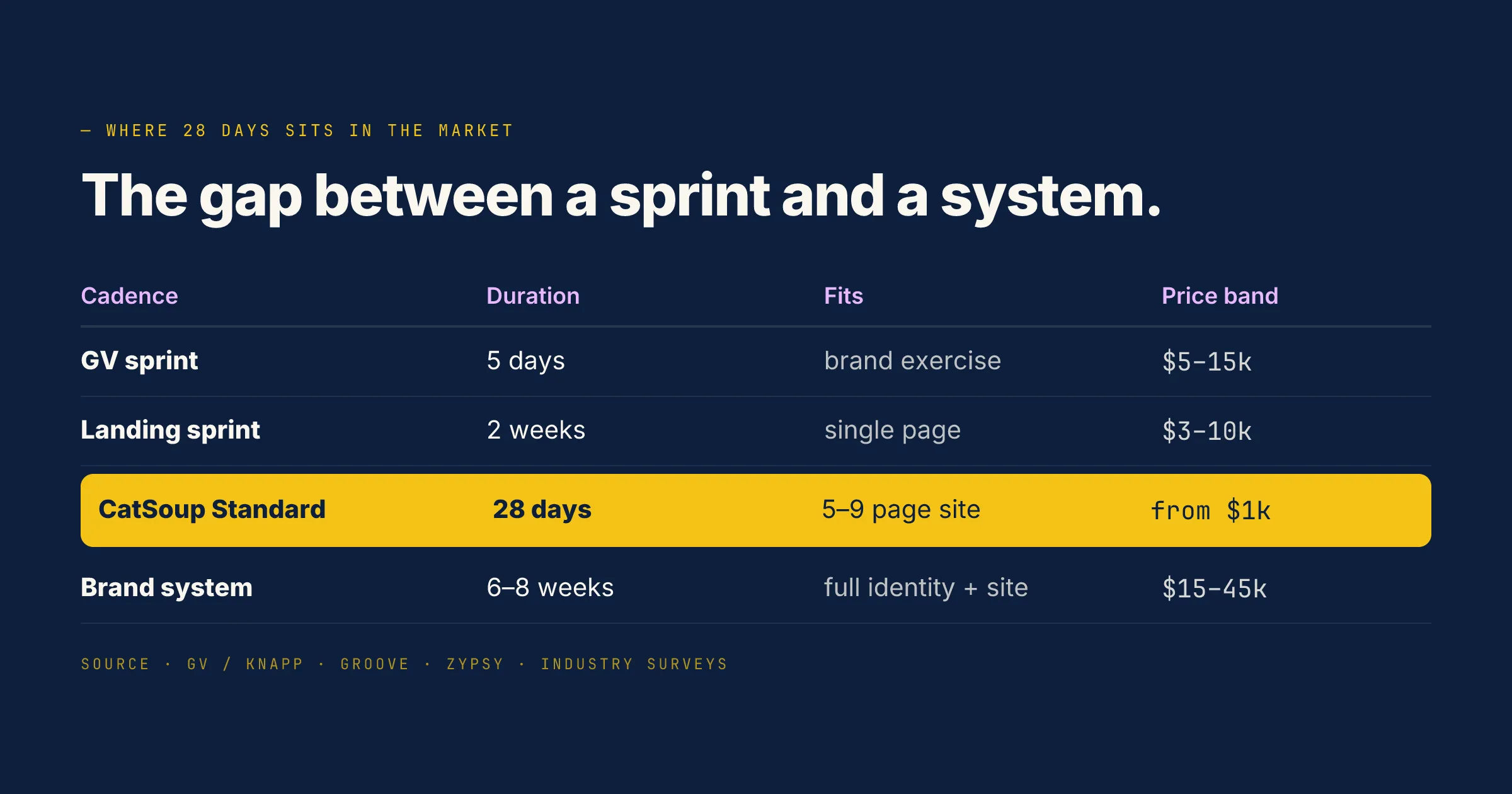
The 28-day slot sits in the gap between a sprint and a system — long enough to ship a real site, short enough to keep momentum.
What if four weeks isn’t enough?
Then the brief is too big for Standard. We say so on the discovery call, scope it as Premium (6–8 weeks) or Elite (custom), and quote accordingly. We’ve never finished Standard “late” because we don’t start the clock until we both agree the brief fits.
If the brief grows mid-build, we have a short conversation: park, pay more, or push. Most of the time it’s park.
— The PM Cat